

“Giving voice to Indigenous marine experts”
2024 – 2026
Indigenous history and ways of knowing are vastly underrepresented in universities on Canada’s West Coast. Students pursuing post-secondary education in marine and coastal fields are often unaware of the context behind much of British Columbia’s marine sector (e.g. fishing, aquaculture etc). The lack of knowledge about Indigenous peoples’ relationship with the local marine environment, combined with the governing structures that we have in place, not only puts students at a disadvantage as they go onto pursue marine careers (e.g. resource management, research, environmental assessment, policy) but furthers the harm to First Nations by colonial education structures. As students graduate and move on to become young professionals in marine fields, they will encounter opportunities in their work to act in the best interest of First Nations, and with added context and understanding behind them, will be better equipped for these opportunities. Therefore, it is of utmost importance to decolonize marine post-secondary education in BC to allow reconciliation to happen in the marine environment.
This pilot program aimed to address this disconnection between universities and First Nations by giving voice to Indigenous marine experts in these colonial institutions through a speaker series designed to transfer their expert knowledge to undergraduate and graduate students. Professors and their students are becoming increasingly interested in incorporating Indigenous ways of knowing into their classrooms but often do not have the connections to make it happen. Additionally, First Nations communities may feel apprehensive about stepping into colonial spaces that have historically caused harm and devalued their knowledge.
As a result of funding:
- Six in-person classroom speaking engagements were held, reaching approximately 75 students and working with four different instructors.
- 13 interviews were conducted with Indigenous Marine Experts from Nations on the South Coast, North Coast, and Vancouver Island. Several of these interviews were conducted on the speakers’ territories or aboard their vessels, helping to ground the stories in place and practice.
- 3 Indigenous students used this program as a focused for their practicum in their final year of a First Nations and Indigenous Studies bachelor program. These students played an important role in shaping the program and supporting interview collection.
- Created an instructor handbook to help educators host this program in a respectful and meaningful way in their classrooms.
- Hosted a storytelling booth at the 2026 Indigenous Seafood Conference, led by Indigenous women and youth, to gather and elevate more stories from women in marine spaces.
- Created a website to house the growing library of Indigenous stories.
- Produced 21 edited videos featuring Indigenous Marine Experts, each paired with written historical context and links to additional resources. Eventually, will produce an estimated 8–10 additional videos, which will bring the library to about 30 videos.
- Built new relationships with professors in science, fisheries, and Indigenous studies at University of Victoria and University of British Columbia, as well as campus groups supporting curriculum decolonization, including the UBC Centre for Teaching, Learning and Technology.
- Developed one draft academic article for publication.
Indigenous marine experts were able to share their knowledge, lived experience, and perspectives directly with post-secondary students. This helped address a clear gap in marine and coastal education by creating opportunities for students to learn from voices that have historically been underrepresented in academic settings. Of the 73 students we surveyed, 54% reported they had never heard from an Indigenous person in their classroom before, while 37% said they had only had that experience one or two times. These findings highlighted both the relevance of the program and the extent to which these perspectives remain largely absent from many learning environments.
Importantly, this work is not simply addressing representation, but who is recognized as a knowledge holder within a university setting. None of the speakers hold university degrees, and some had never set foot on a campus before. Yet through this program, their life’s work, expertise, and knowledge were recognized and valued within an institution that has historically privileged other forms of authority. Professors and speakers shared that these exchanges created a sense of mutual respect, with participants engaging with one another as colleagues. That relational shift is an important step toward longer-term institutional change.
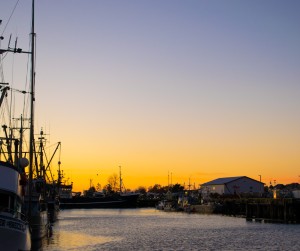
Credit: Native Fishing Association
View of fishing boats at sunset in Steveston, a historic fishing port near Vancouver, BC.
A few key insights from this work:
- Coordinating classroom speaking engagements through universities is highly relationship- and labour-intensive. This has pointed us toward partnering more intentionally with decolonial and Indigenous-focused campus groups, who are often better positioned to help guide this work within their institutions. This will shape our approach in the coming year.
- The most impactful classroom engagements and interviews are those that centre storytelling, rather than asking marine experts to lecture in a conventional academic format. One challenge early in the program was that many speakers wanted to share a great deal of knowledge but struggled to decide what to share and how to share it effectively. We found that centering storytelling helped address this, allowing speakers to convey meaningful experiences in a focused and impactful way. Storytelling creates an emotional connection that can bridge the very different lived realities of students and fish harvesters, making the learning more memorable and meaningful. Storytelling is also more in line with Indigenous ways of learning and knowledge sharing.
- Universities are highly interested in Indigenous knowledge sharing and in creating stronger connections between learners and Indigenous knowledge holders. At the same time, many institutions are still struggling to do this consistently, respectfully, and in ways that are meaningful for everyone involved. An important impact of this program is not only the direct learning it creates, but also the roadmap it offers for how this kind of engagement can be done well. That roadmap is being shaped collaboratively through the contributions of Indigenous professors, Indigenous students, and Indigenous marine experts as the program continues to evolve.
Advice for others
- If you are not part of the demographic you are serving, focus on approaching your role as one of support rather than leadership. Listen actively, follow the guidance of those who are part of the community, and create structures that allow their voices to drive decisions. You’ll make mistakes, and when you do, learn from them and keep going.
- Doing anything for the first time will be a learning process. Projects that prioritize authentic community engagement take time, and your role may involve adapting processes, stepping back when appropriate, and creating space for community members to shape the work.
About the Native Fishing Association
The Native Fishing Association is a not-for-profit organization established in 1985 by the Native Brotherhood (oldest Indigenous organization in Canada; est. 1931). The Association’s purpose is to foster and support the success of First Nation men and women in the commercial fishing industry. The NFA provides loans, grants, shared licenses and quotas, and a variety of support services to help grow Indigenous fishing businesses.